Even more e-readers, and mobile thoughts

At our annual Staff Day extravaganza on Columbus Day, Columbus Metropolitan Library‘s director Patrick Losinski gave a nice keynote about today’s library challenges and opportunities. His library concentrates on three key constituencies: young minds, power users, and virtual users. I think these are three sets of people you’d do well to make your primary service groups…

And speaking of power users and virtual users, I’ve kept rounding up the e-reader news & thinking about the issues. Check it out:

B&N E-Reader goss as well as SCOOP!

Spring Design reader will reportedly feature the Android OS

NYT weighs in:
Libraries & (digital) readers
and also
Brains and electronic reading

Mother Jones on ecological aspects of e-reading

The coming explosion!

Since my last rather ranty post about e-readers & such electronic devices, the field has gotten crowded with competitors and announcements. 2010 is totally going to be the year of the e-reader!

Time previews some of the new devices

Barnes & Noble will have their own reader for customers

Amazon answers with a price cut & international Kindle access!

Speculations over tablet PCs from Asus and Apple include e-reader capabilities & design

LG’s solar powered reader has promising niche appeal, could be huge in remote/rural places & emerging markets like Africa, etc.

And bloggers do the roundup of developments at the AtlanticWire

What this all boils down to, of course, is that computing is becoming even more mobile and interactive. Being able to manipulate interfaces directly a la the iPhone makes tablets ultra-droolworthy, and the emergence of a mainstream e-reader market has come from the desire of the contemporary reader to engage with text flexibly & digitally. Our silicon ways (wouldn’t that make a great band name?) have brought us to an interesting juncture – truly ubiquitous computing may be right at our fingertips.

I’m gonna tweet ur old-skool stuff!

One of the newest trends I’ve been following? Republishing older, public-domain works in installments online. This definitely proves that everything old can be new again! Ranging from the revered and famous to the unknown and pedestrian, people are rediscovering the pleasures of slowly getting a story in bite-sized chunks. Check them out below:

John Quincy Adams’ diary entries brought to you by the Massachusetts Historical Society:
http://twitter.com/Jqadams_mhs

Samuel Pepys can help you relive 1666 all over again:
http://twitter.com/samuelpepys

Dracula is republished in real-time on this blog:
http://dracula-feed.blogspot.com/

Tail-end of the Great Depression through the eyes of a girl in rural Illinois:
http://twitter.com/Genny_Spencer/

The Orwell Prize is republishing the writer’s diaries in blog form:
http://orwelldiaries.wordpress.com/

If you know of others, let me know and I will add them to this post.

I downloaded a book (and I liked it… sort of)

I felt as though, after my last post, I should play more with electronic books so that I can speak from a position of experience. So, I fired up my Kindle app on my iPhone – downloaded only because it was free – and flipped through my purchases, such as they were. I had only downloaded a short story and a few sample chapters, so I had no real experience at extended reading on my phone.

Because I’ve been enjoying the TV show True Blood based on Charlaine Harris’ novels, I decided to try the first in her Sookie Stackhouse series. I had flipped through them years before, and thought I might give them another try. After all, reading tastes change and I needed an “average” book to try out: something I would have bought in paperback, not too long or too short, just an average sort of book in order to get an average experience reading using Kindle.

Well, that was a mistake.

Dead Until Dark was a fun little book. So fun, in fact, I was eager to see what happened next in the series. And with an electronic book, all you have to do is hit the download button. It’s like a direct delivery system for book addicts; Kindle crack, if you will. The rush of instant gratification was a little magical and a little thrilling. There I was, in the backseat of a car, and within moments I was reading the continued tales of a vampire-dating waitress from Louisiana. I was about as happy as a real book lover could possibly be.

But that feeling didn’t last very long after I was done. For me, books are just about as social as anything else in the world. So of course I started thinking of people I would recommend this series to. And I realized that I could recommend all I liked, but that I wouldn’t be able to lend them my copies of the books! I’d have to hand over my phone in order to lend out my “books.” And in my mind, that’s a big loss. One of my big readers’ advisory mantras is that recommendations are only as good as your ability to connect the reader and book as fast as possible. Nobody likes to wait, and there’s a reason why Big Chain Bookstores engage in the “here, let me hand you the merchandise” practice: it cements the deal.

So while the e-book version was convenient for me as a solitary reader, it led me into a dead end. Even if I was able to “gift” my digital copy to another reader, it would still only be able to be read on an iPhone or a Kindle itself. I think the experience left me a little poorer than it found me – although now I’ve read the books, I’m not able to share that with other people unless they are willing to pay about $6.00 and go out to find the books themselves.

I’m inclined to think that this hurts the publishing industry more than it supposedly helps them. I rarely lend out an entire series of books, but I frequently lend the first copy in a series to friends and colleagues who are willing to give them a try. How many subsequent sales does that drive? Also, the price point seemed pretty arbitrary to me. I could pay between $2.00-$6.00 for a used paperback copy for the same book locally, and have the residual value of the physical book left over for sharing, etc. In theory, e-books are so cost-efficient to deliver to the consumer that it totally disrupts the distribution model. You only need one copy of the book on a central server to make a copy of for each reader, so I hope more of the profits would go to the writer (but I strongly suspect this isn’t really the case). And finally, publishers are losing their cheapest form of free advertising. Nobody I encountered that day knew I was sitting there reading Dead Until Dark. They had no clue. When carrying around a physical book in public, I usually get at least basic questions from people I encounter like “is that any good?” or “do you like it?” Now those chance encounters are all closed off.

So in the pros column, we have convenience and portability as well as instant gratification. But in the cons column, I experienced a lot of frustration in trying to share my reading experience. E-books also seem expensive given their limitations and restrictions.

While I won’t be repeating this experience with downloadable audiobooks (I am notoriously unable to listen to books, so it wouldn’t be a fair experiment), I do feel like I’ve gotten more insight on the electronic reading experience. If anyone has thoughts to share, I’d like to hear what you have to say in the comments section.

Just call it my Babel wish…

I spent an hour with a patron the other day trying to figure out why, suddenly, her MP3 player refused to let her listen to audiobooks from one of our vendors. It worked before… and now, it wouldn’t.

She just wanted to lend it to her students, and let them listen. It turns out that the software installed on her player is a huge problem for nearly everyone, and she would have to reformat the player to even attempt to get it to work.

Digital Rights Management, in its current form(s), effectively prevents libraries from delivering the information people want and need. DRM controls how a digital copies of audiobooks, songs, and e-books are decoded by the consumer, and is seen as essential to preserving the rights of creators and distributors. While DRM prevents people from easily copying and distributing these works, it also prevents them from easily consuming them. The industry seems unwilling to agree on a single standard that would work on any device, instead choosing to elaborately encode digital files with competing technology.

And that’s where libraries come in. We are dedicated to bringing patrons the media they want and need, but now find ourselves at a crossroads: there are stories and information out there that are impossible for us to provide to our patrons because of DRM. The perfect example is the novella Ur by Stephen King. Since this story is only available on the Kindle reader from Amazon, we cannot purchase a copy to lend out. Some interpret the Kindle terms of service to mean that you cannot lend the actual device to another person to read the books, which is pretty draconian, but it is certainly well understood that it is a violation of their terms of service to transfer the purchase to another device – in other words, we couldn’t even buy a digital copy of the story to lend out to patrons on their own devices! That’s as ridiculous as telling someone that they are only allowed to read in certain rooms of their house, but it’s roughly the equivalent.

If we come back to my poor patron who could not wrestle her MP3 player’s software into submission, we can also see how DRM can ruin the audiobook experience as well. If you’ve never attempted to borrow a downloadable audiobook from a library, the pitfalls are many: computer issues, device issues, and software issues – oh my!

First, our library blocks downloading at patron computers. That means that when we are attempting to help a patron with their audiobook, we are typically coaching them over the phone or the internet. The process is especially challenging because the patrons may not be computer savvy in the first place, and may need help with basic tasks that are totally foreign to them. Then you have to determine if their cell phone, MP3 player, or other device is compatible with your vendor – we use NetLibrary/Recorded Books and Overdrive between the audiobooks we’ve bought and the ones we get through our State Library. Even if their device is listed as compatible, they may have some sort of strange software pre-installed by the manufacturer that cripples the process. Finally, there is usually some sort of download involved to the end user’s computer in order to translate the DRM coding on the receiving end – and that may not work perfectly and need additional troubleshooting.

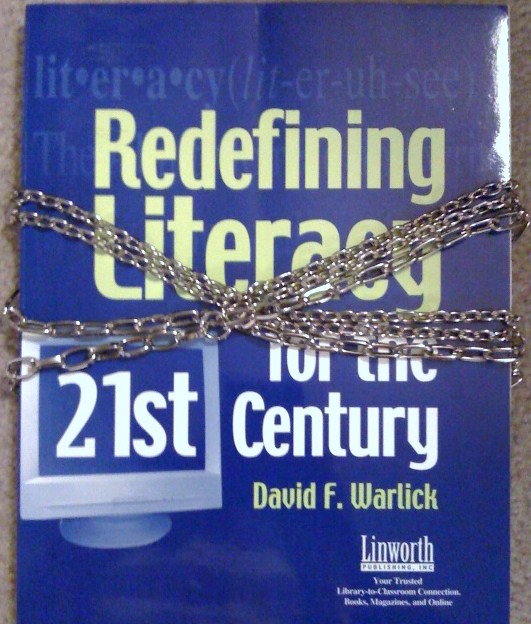
While DRM is a component of digital files that can potentially protect copyright and ensure that authors aren’t missing out on hard-earned revenue, the industry has failed in its execution (especially where libraries are concerned). When I hand a(n) (audio)book to a patron, I don’t tell them that they can only read it in their dining room or in the bathtub. They can take it to the beach, listen on their commute, or read in bed for all I care. Using DRM to restrict digital files to certain devices or certain software is the 21st century equivalent of deciding the medieval monks got it right by chaining books to the shelves so nobody would make off with them!

While in the past there might have been merit in standing back and letting the industry develop a standard, as in the VHS vs. Betamax format war of the late 1970s, I don’t think today’s libraries have this luxury. Our patrons are depending on us to deliver information to them that works no matter which device they have purchased, not to sit around waiting to see what sort of highly restricted, totally proprietary system that various publishing industries will invent. It’s not out of the question to imagine Rhapsody and the Sony Reader e-inking an exclusive deal with one set of publishers/record companies, while another set decides to provide content only to Amazon Kindles and iTunes. How would we provide access then?

The future of publishing is content that is device agnostic. We need a standard that allows for both ease in downloading and copy protection. And libraries could make this happen sooner than you think.

If publishers want to know what’s in it for them, I can tell you right now that it’s spelled SALES. Adopt a common currency for distributing media files, make it easy for people to use them, and the money will certainly follow. Libraries are crazy about downloadables anyway because they eliminate the possibility of damage or inevitability of replacement that you get with physical copies of media. (Consumers like all that too, by the way.)

The American Library Association estimates that there are around 123,129 libraries in the United States alone. If each library were to donate just $5 to a common fund, we could start a competition much like the X Prize Foundation. That’s a pot of over $600,000 as a prize for developing the best universal DRM system ready for immediate and cost-effective adoption by the publishing industry. I’m willing to throw in the first Lincoln! I’ve been calling it my private Babel Wish, but I’m open to better suggestions now that I’ve gone public.

We have a professional obligation to collaborate in ways that expand access to knowledge. This would be one powerful way to do it. Are you in?
Techy Talk via OPAL!

I gave a little talk today to folks from all over the world online! It was delivered via OPAL (Online Programming for All Libraries) and it’s still going strong – I’m definitely tuning in tomorrow for more awesome talks!

In these budget-crunching times, an online conference is a great way to network and learn without traveling and spending a lot of dough. I was pleased to talk about education, libraries, and technology… and pleased to see so many interested “faces” in the crowd!

Check it out at OPALescence (my page is here)! It’s FREE, it’s ONLINE, and it’s EASY. Things don’t get awesomer than that!!!

Uglies free online!


One of the most popular series for teens is a limited-time free download in .pdf format! Of course, they’re promoting Westerfeld’s newest book, Leviathan, but who can complain about that? As more and more publishers make their works available in online forms, I can see more and more ways that you could leverage this free/cheap material for classroom use. Of course, the best aspect of the online text is its infinity – instead of having to police limited numbers of physical copies and tell students to hustle and read so others can have access too, every student could log in and read online, or download to their personal device– no waiting.

On a related note, education stands to gain the most from asking publishers to give up on DRM and concentrate on better ways to maximize revenue.

Book Review: Columbine by Dave Cullen


I reviewed this on my Goodreads account but I think it bears repeating here. Such a compelling work!

Dave Cullen’s thoroughly researched and evenhanded account of the 1999 Columbine High massacre is a superior work of non-fiction. Published to coincide with Columbine’s ten-year anniversary and drawing on his six-year old Salon piece “The Depressive and the Psychopath,” Cullen weaves together the riveting details of the events surrounding the killings. His telling of the story is decidedly non-linear, and creates a roller coaster-style narrative from the beginning. Just as we settle into a section describing the lives and motivations of the Columbine community, Cullen jerks us back into the world of Dylan Klebold and Eric Harris– forcing readers to confront the fact that no “outsider” committed these crimes.

Cullen’s triumph may be in the quiet, matter-of-fact way he debunks the commonly held myths about the events. He cites a wide variety of sources to show readers things like Klebold’s hidden, unrequited loves and the girl in the library who professed her faith in God (not Cassie Bernall, as was widely attributed, but Val Schnurr– who lived to feel guilty about telling the tale).

Perhaps the most pervasive myth Cullen shatters is the conception that these killings occurred through a lack of empathy, of bullying gone overboard. It’s very difficult to read the psychiatric analysis of Eric Harris and to understand that his grandiosity and rage was merely symptomatic of a psychopath– that no loving care could have soothed him because he was detached from the normal range of human emotion.

Readers may not be reassured by Columbine, nor filled with hope or optimism. A quiet sense of loss pervades its pages. Cullen tells the story that begs to be told in its entirety both dispassionately and honestly; who of us could ask for more?

Relax. It’s just a book.

It’s summer, so you know what that means at the public library… a deluge of kids and parents looking for books! It’s great to see so many people who encourage youth to participate in summer reading. But why is finding the “right” book so difficult? While there are a lot of kids who sit in the aisles happily riffling through pages and browsing away, some parents are stressed about the process. We get requests at the reference desk for books specifically for second graders, and some parents struggle to define the sort of reading that they believe their kids should be doing.

Parents worry that their kids want to read books that don’t seem challenging for them, or that there is a problem because all they want to read is the next in a series, or that they reread books over and over again and are not “making progress.” They would like us, the librarians, to fix the perceived problem by recommending books that will alleviate these deficiencies in their kids’ reading habits.

It’s reassuring and unnerving, I know… but there is no right book. Rereading is perfectly fine. Series fiction is fabulous. Nonfiction titles are legitimate reading. What makes the difference is offering kids a wide variety of reading choices and then stepping back to let them actually choose.

If you think about it, there are few choices that kids get to make that are their very own. Let reading be an activity where they are in the drivers’ seat. Help them find a book that has a story that intrigues them, excites them, scares them, or attracts them in some other fundamental way. Let them read widely if that’s what they’re into right now, or help them find that 100th book about the Titanic or Ancient Egypt or whatever topic they are obsessing about at the moment.

Even more than that, you should be checking out books too. Find a magazine that you like, or a novel of your own to check out as well. Everyone in the family needs to read for pleasure if you want young people to see that reading is an activity with value. They will want to do what they see you doing, so engage in reading alongside your children. Research has even shown that the more time you give kids to simply read for pleasure, not towards a goal or for another purpose, the better readers they become.

So really relax this summer. Don’t make reading a chore, and don’t stress out about it. Just make it part of your daily lives, and encourage young people to read something of their own choosing. Let the library be an enjoyable haven for both you and your kids!

Welcome to the 21st century library

I am a survivor of many a teen gaming tournament. I’ve organized and worked at both computer and console gaming events in several libraries, and I can say without a doubt that it’s plain hard work. And it’s worthwhile work – I’m just as likely to ask a reluctant reader what games they like to play in order to help them pick out a book as I am to ask them about their favorite movies and TV shows. If I was totally out of touch with gaming and other activities that teens love, I would not be able to effectively connect young people to all sorts of media – including books.

If librarians look like they’re having fun on the job, it’s because we love what we do, not because we get to sit around playing games all day. Unfortunately, this is not the case in Nebraska, where some are accusing the State Library Commission of being wasteful stewards of taxpayer money by purchasing and learning to use gaming equipment with the intent to train public librarians in their state.

This sort of training is needed – in my current library system, we had to hold trainings and create a usage manual for our gaming kits. Using gaming equipment is not exactly an intuitive process, and we need to be just as prepared for gaming programs as we do for any other programs. If librarians didn’t study up on games before presenting them to the public, it would be like not reading the book before showing up to facilitate a book group. Or not trying out a database before teaching a patron to use it.

Gaming in libraries is important for several reasons. Reluctant users can see that librarians are aware of and appreciate the activities that are important to them. The library can become less intimidating and comfort can be established for young patrons who are underserved or unserved. Gaming also creates community for patrons who are highly social, helping gamers connect with like-minded people. Libraries collect stories of all kinds, and they can be found in books, music, movies, and games!

But it’s not easy to do. There’s a lot of work involved. And while it may look like we’re just playing around, librarians are gaming with a purpose: to help young people through our doors and into the larger collection – for life-long learning and community building. It looks unorthodox, it may be noisy and boisterous, and it challenges long-held stereotypes about libraries and library atmosphere. Welcome to the 21st century library!

For more information about how our library has phased gaming into our regular services, check out my VOYA article: So You Wanna Play Games? A Start-up Guide for Gaming in the Library.